|
Bow Shock Runaways (BSR)
|
A fraction of massive stars in the Milky Way (up to several %) is known to be characterized by significantly high systemic velocities, allowing them to move away from their birth place on a time scale shorter than their evolution time scale. Their atypical kinematics can result either from dynamical interactions in dense stellar clusters, or from the kick underwent by the star initially in a binary system due the supernova explosion of the companion. These so-called runaway stars are thus in position to cross interstellar regions still filled with a significant amount of material.
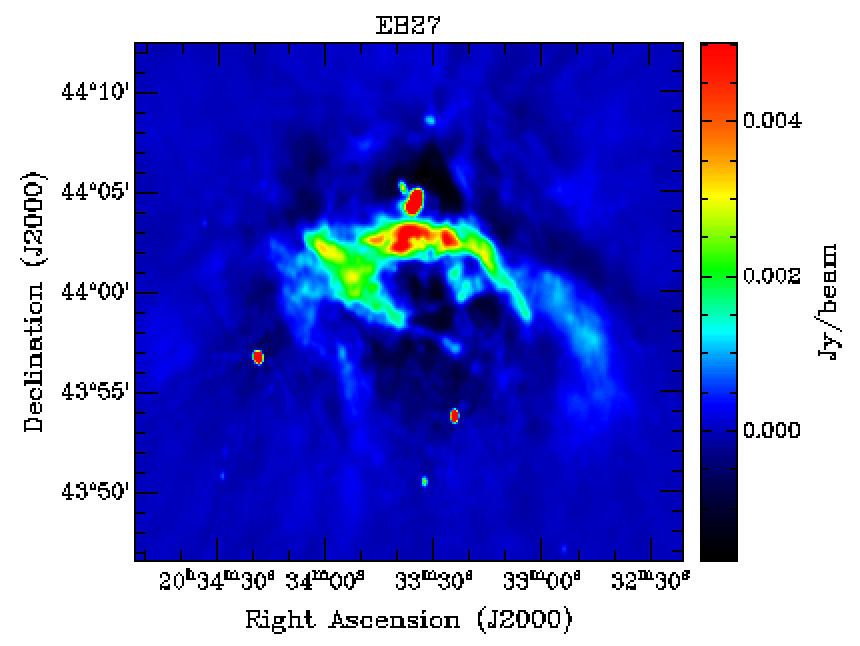
The net result is that their stellar winds will produce bow shocks as they interact with the interstellar material. The resulting shocks constitute adequate sites for Diffusive Shock Acceleration, and bow shock runaways are thus likely to produce non-thermal radiation. Such a non-thermal emission has been revealed in the case of the EB27 bow shock close to BD+43 3654, presenting compelling evidence for synchrotron radiation (Benaglia et al. 2010, 2021).
Radio map of the EB27 bow shock associated to the massive star BD+43 3654 (Benaglia et al. 2021).
Questions addressed in this context include: