My research activities deal with several topics, including physics of massive stars, shock physics, high energy and radio astrophysics, and cosmic-rays, along with some interest in astrochemistry and the influence of massive stars on astrochemical processes. A few selected topics are briefly described below
Particle acceleration in massive stars:
The acceleration of particles in astrophysical environments is a major question at the forefront of high energy astrophysics. Although the most famous cosmic particle accelerator are objects in quite extreme conditions (supernova remnants, gamma-ray bursts, relativistic jets in extragalactic objects...), massive stars turn out to be able to produce cosmic-rays (high energy charged particles such as electrons, protons, helium ions, heavier ions...). Even though the intrinsic efficiency of pre-supernova massive stars is not expected to be as high as that of supernova remnants, for instance, their contribution to the production of low energy (below GeVs) Galactic cosmic-rays may not be negligible. My main research activities concern the study of such objects, mainly in two particular configurations: massive binaries and runaway stars.
My main research topic is that of particle-accelerating colliding-wind binaries (PACWBs). These systems are mainly identified as particle accelerators on the basis of the detection of synchrotron radio emission (requiring a population of relativistic electrons), even though detections in the high energy domain are also considered. These objects are now compiled in a catalogue published in 2013 (ADS). The catalogue is regularly updated as progresses are made and its on-line version can be accessed here.
In these systems, the particle acceleration process is believed to be Diffusive Shock Acceleration (DSA) in the region where the stellar winds of the two massive stars collide. The physical conditions ruling the acceleration process are thus dictated by the stellar wind properties, and are expected to vary as a function of the orbital phase if one is dealing with an eccentric orbit.
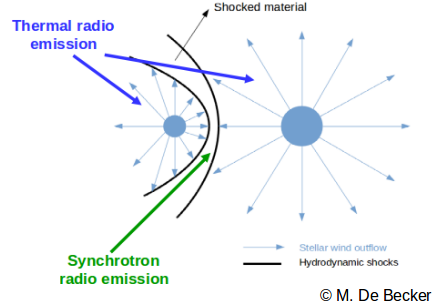
Schematic view of a colliding-wind binary including shocked gas between two hydrodynamic shocks.
Research on this topic involves:
the determination of the orbital parameters of these ssytems, using both spectroscopic and interferometric techniques,
the determination of their radio spectral properties through observations with radio observatories such as EVLA, ATCA, GMRT, along with VLBI facilities (LBA, EVN,...),
the theoretical investigation of the radiative processes at work in such systems, in order to derive information about the injection of energy in the particle acceleration and non-thermal emission processes,
the investigation of these systems in hard X-rays and gamma-rays. The existence of relativistic electrons is indeed expected to feed an inverse Compton scattering process, and relativistic protons should be involved in hadronic processes such as in the case of Eta Car,
the search for new members of the catalogue, using mainly radio observatories, in order to address the issue of the fraction of particle accelerators among colliding-wind binaries.
On the other hand, another class of massive stars turns out to be able to accelerate particles: the so-called Bow Shock Runaways (BSRs). Massive runaway stars (ejected from their formation site) are likely to cross various interstellar regions. Along their way across interstellar clouds, their strong stellar winds will interact with the surrounding interstellar material and produce shocks. In the presence of such hydrodynamic shocks, the DSA mechanism can operate and accelerate particles.
Research on this topic involves:
the search for synchrotron radio emission from BSRs to evaluate their particle accelerator status,
the investigation of BSRs in X-rays in order to search for a non-thermal X-ray emission component (inverse Compton scattering) coincident with the bow shock, and therefore slightly off set with respect to the star itself,
to feed adequate models in order to understand the non-thermal physics operating in such environments, and evaluate the capability of these objects to accelerate particles.
These activities are part of the PANTERA international collective.
X-ray emission from hot, massive stars:
X-ray observations constitute a powerful tool to investigate the physics of stellar winds of massive stars, and shock physics in colliding-wind binaries. The rise of the plasma temperature up to millions, or even tens of millions of K in such objects leads to the production of X-ray emission lines on top of a bremsstrahlung continuum.
The investigation of single stars provides relevant information of their stellar winds at various evolutionary stages (see e.g. papers published in 2013 and 2014).
In massive binaries, a modulation of the measured X-ray spectrum is expected with a time-scale corresponding to the orbital period. This has been investigated for instance in the cases of HD168112 and Cyg OB2 #8A. The variability can be explained by a combination of changing emission due to an eccentric orbit and varying absorption along the line of sight depending on the geometry of the system.
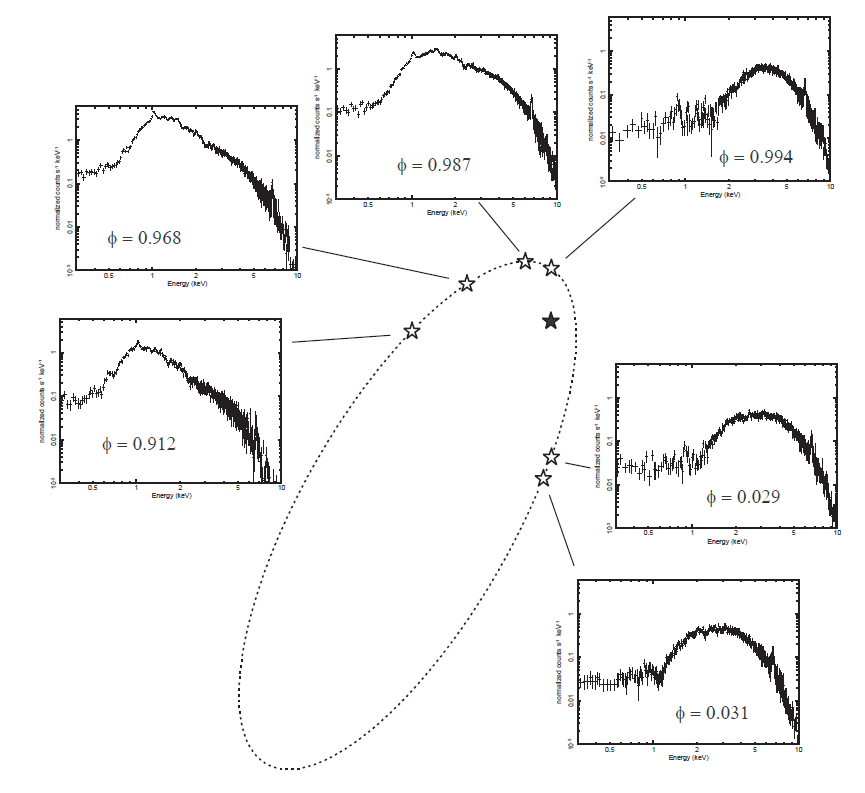
Projected orbit of WR140 along with X-ray spectra obtained with XMM-Newton at various orbital phases. Figure taken from De Becker et al. 2011, BSRSL, 80, 653.
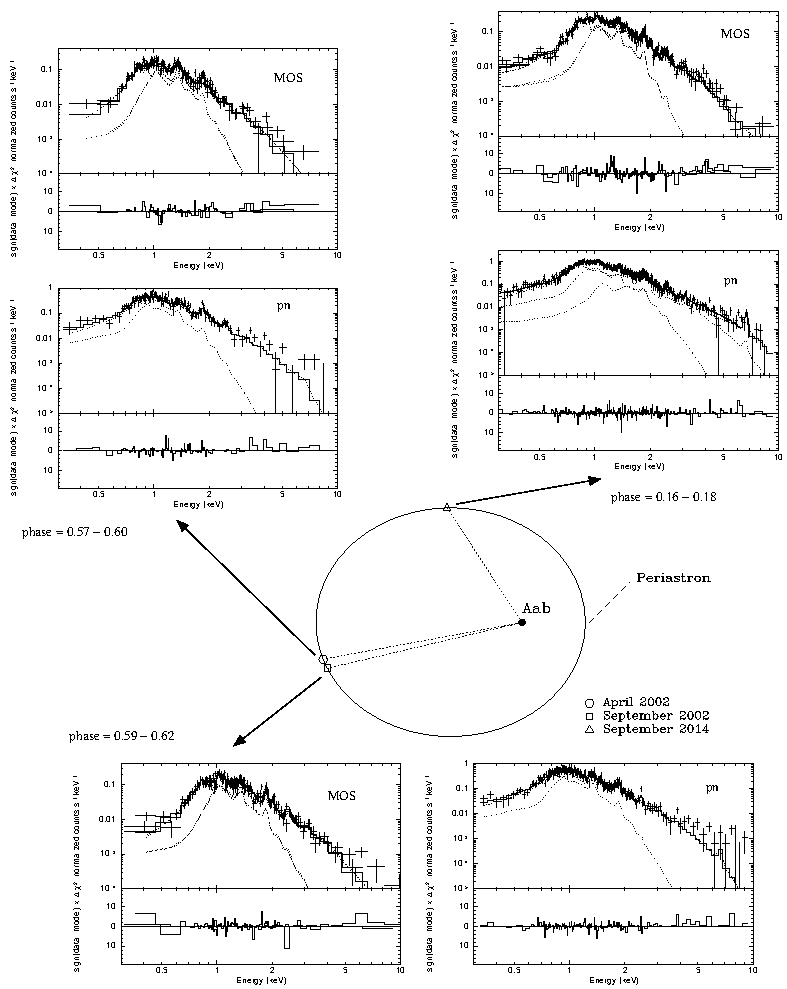
Projected orbit of the triple system HD167971 along with X-ray spectra obtained with XMM-Newton at various orbital phases. Figure taken from De Becker 2015, MNRAS, 451, 5589.
The influence of massive stars on astrochemical processes
Even though massive stars constitute a small fraction of the stellar population in our Galaxy (about 1 ppm), their impact on their environment is highly significant. It is now well-known that they are important providers of ionizing radiation. In addition, they eject huge amounts of material and mechanical energy in the interstellar medium through stellar winds and supernova explosions.
However, their specific role in the activation of many physico-chemical processes in interstellar clouds should be emphasized. Whatever their evolution stage, either in single or binary configuration, many aspects of the physics of massive stars are highly important for astrochemical processes. This issue has been reviewed in this paper.
Summary of the influence of massive stars on astrochemical processes. Figure taken from De Becker 2014, Ap&SS, 350, 237.
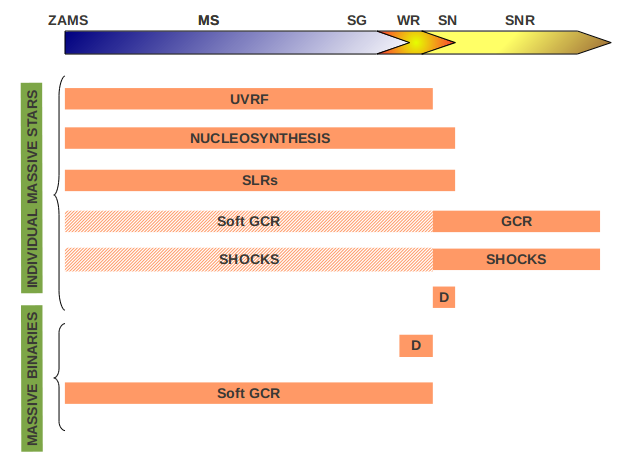
In particular, I am especially interested in the influence of cosmic rays generated by massive stars (see the topic on "Particle acceleration in massive stars" above) on the energetic processing of molecules of astrochemical interest.
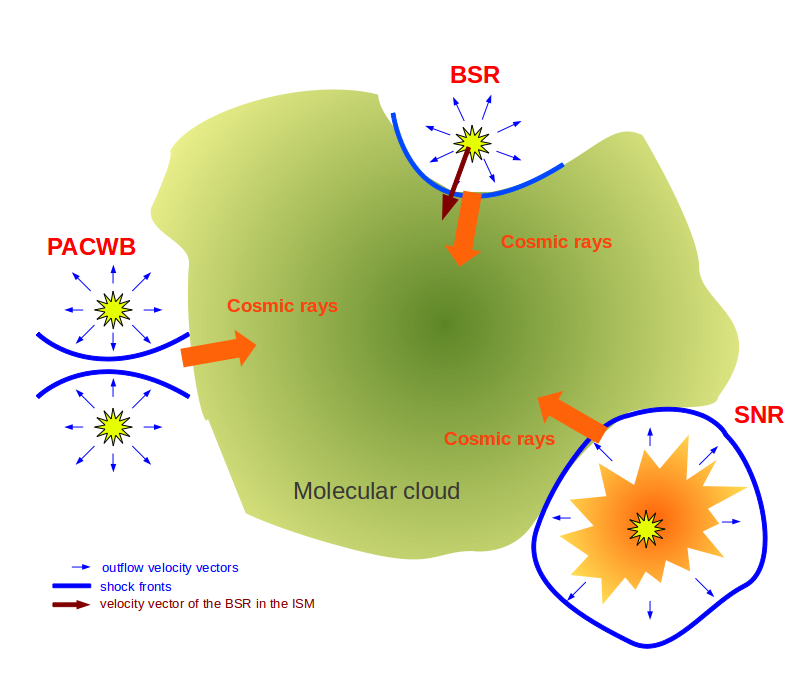
Schematic view of a molecular cloud, in the presence of sources of cosmic-rays such as a
Bow shock runaway, a Particle-Accelerating Colliding-Wind Binary and a Supernova Remnant. Figure taken from De Becker 2015, Bull. Soc. Roy. Sci. Liège, 84, 15.
Astrochemistry:
Between 2013 and 2015, I was the coordinator of the activities of a Working group dedicated to astrochemistry. This Working Group aimed at studying physico-chemical processes in space conditions in order, notably, to explore the broader issue of molecular complexity. The activities of this working group covered either processes in the gas phase, on surfaces, or even in solid matrices, and aim at exploring prospects for the definition and exploitation of ground-based or space-borne laboratories designed for astrochemical and astrobiological purposes.
In this context, I was the main organizer of an international workshop entitled "Experimental astrochemistry: from ground-based to space-borne laboratories" (ExAc2014). The web page of the ExAc2014 workshop can be accessed here.